Should You Change the Way You Run?


There is no single correct way to run. Before changing your stride to prevent injury, understand what the research says about running technique, training load and injury risk.

Running is a popular way to improve fitness, maintain an active lifestyle and challenge yourself. But running injuries are also common, particularly when you increase your training or return to running after a break.
It's understandable that when pain develops, you start questioning whether the way you run is contributing to the problem. Should you change from heel striking to forefoot striking? Take shorter steps? Increase your cadence? Or work on your running posture?
The reassuring news is that most runners don't need to completely change their running technique. Your natural running style is influenced by your individual anatomy, strength, mobility and experience. Rather than chasing a perfect running style, there are often more important factors to consider when managing injury risk.
What is Running Technique?
Running technique, sometimes called running gait, describes how your body moves when you run. It includes several characteristics that influence how forces are produced, absorbed and transferred through your body.
Some of the most commonly discussed aspects include:
- Cadence: The number of steps you take per minute while running.
- Foot strike: The way your foot first contacts the ground. This may be heel-first (rearfoot), midfoot or forefoot.
- Stride length: The distance covered with each step, including how far your foot lands in front of your body.
- Running posture and movement: How your hips, knees, ankles and trunk move and work together throughout each stride.
These characteristics vary considerably between runners. Your height, limb length, strength, mobility, running experience and even the speed at which you run can influence your technique.
There is no single combination of these characteristics that every runner needs to achieve. What works well for one person may not be necessary or appropriate for another.
Does the Way You Run Actually Cause Injuries?
This is where the research becomes interesting. There is a common belief that certain running styles are inherently dangerous and that correcting poor technique will prevent injuries. However, the evidence doesn't support such a straightforward relationship.
Research examining running biomechanics has found that no single biomechanical characteristic consistently predicts which runners will develop an injury. Some studies have identified associations between particular movement patterns, such as increased hip movement or higher impact loading, and certain running injuries. However, these findings are not consistent across all runners or injury types. In other words, a movement pattern that appears unusual in one runner may be perfectly comfortable and well tolerated by another.
This doesn't mean running technique is irrelevant. It means that technique needs to be considered in the context of the individual runner, rather than assuming that a particular foot strike, stride length or posture is automatically a problem. For most recreational runners, there are other factors that deserve greater attention before making changes to their running style.
So What Actually Causes Most Running Injuries?
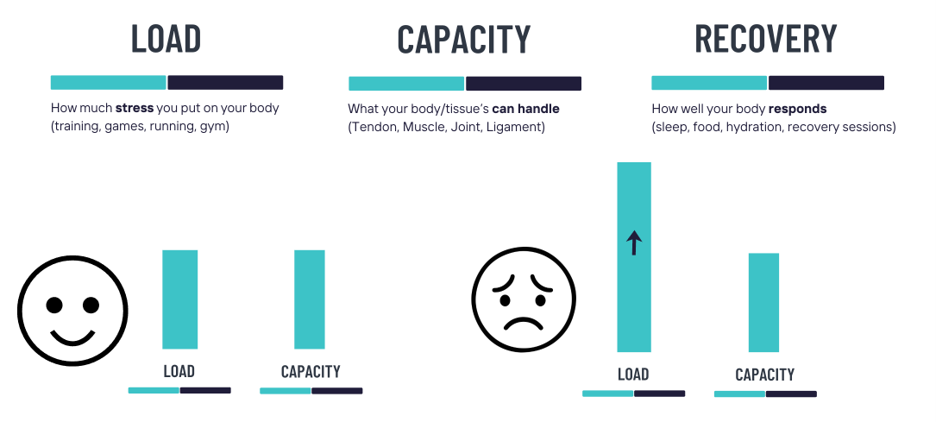
Running injuries are often associated with a mismatch between the physical demands of training and your body's ability to tolerate those demands.
Three important factors to consider are training load, physical capacity and recovery.
Training load
Training load refers to how much running you do, how often you run and how hard you train.
Increasing your weekly distance, introducing speed sessions or adding hill training can all increase the demands placed on your body. Problems can arise when these demands increase faster than your muscles, tendons and bones can adapt.
This is particularly relevant if you are returning to running after a break, starting a new training program or preparing for an event.
Physical capacity
Physical capacity describes your body's ability to tolerate the demands of running.
Your muscles, tendons, bones and joints need sufficient strength and capacity to cope with the repetitive forces involved in running. If your training demands exceed your current capacity, you may become more susceptible to developing an injury.
Regular strength training and progressive running programs can help build this capacity.
Recovery
Your body needs time to recover and adapt between training sessions.
Insufficient recovery, poor sleep, inadequate rest between harder sessions or repeatedly running through pain can make it more difficult to tolerate increasing training demands.
These three factors work together. Injury risk is influenced not simply by how much you run, but by how that training compares with your current physical capacity and how well you recover.
A gradual approach to increasing running distance and intensity is generally sensible. Rather than relying on a rigid rule such as increasing your distance by no more than 10% each week, consider your recent training history, experience, recovery and how your body responds to changes in workload.
Should You Change Your Running Technique to Prevent Injury?
For most runners, deliberately changing their running technique simply to prevent injury is not supported by strong evidence.
Trying to force a different foot strike, shorten your stride or change your running posture can introduce unfamiliar forces through your muscles, tendons and joints.
Your body needs time to adapt to these changes. If you make significant adjustments without appropriate preparation, you may simply shift the loading elsewhere and create a new problem.
This is particularly important if you are currently running comfortably and don't have an injury or specific performance goal that warrants a change.
Rather than trying to correct something that may not be a problem, focus on building your running capacity, progressing your training sensibly and allowing enough time for recovery.
Can Changing Your Running Technique Ever Help?
Yes. Although changing your running technique isn't necessary for everyone, there are situations where it can be beneficial.
Improving running performance
Some runners may benefit from small, targeted changes to their running mechanics to improve running efficiency or performance.
For example, a modest increase in cadence (steps per minute) or a reduction in excessive overstriding may help improve running economy or alter the forces experienced by particular joints.
However, these changes need to be appropriate for the individual runner. There is no universal cadence target or ideal foot strike that everyone should aim for.
Managing persistent running injuries
For some runners, a specific change in running mechanics may help reduce the load placed on an irritated or overloaded structure.
This is particularly relevant when an injury continues to return despite appropriate adjustments to training load, strengthening and rehabilitation.
Gait retraining involves making small, deliberate changes to running technique to influence how forces are distributed through the body. It is best considered following an individual assessment to determine whether a change is likely to be useful.
Importantly, gait retraining is a targeted treatment approach, not a blanket injury prevention strategy.
If you're experiencing a recurring running injury, read our companion article: Running injury keeps coming back?
What Should You Focus on Instead?
If you're running comfortably and want to reduce your likelihood of developing an injury, there are several practical things you can do without changing your natural running style.
Build your running gradually
Increase your weekly distance, running frequency and intensity progressively. Avoid making several significant changes to your training at the same time, particularly when returning after a break.
Develop your strength
Include regular strengthening exercises that target your legs, hips, calves and trunk. Improving your strength and physical capacity can help prepare your body for the repeated demands of running. Our article on strength training for runners explains how a simple strength program can complement your running.
Allow time for recovery
Balance harder training sessions with easier days and adequate rest. Pay attention to persistent fatigue, changes in performance and symptoms that aren't settling between runs.
Listen to your body
Some muscle soreness following exercise is normal, particularly when introducing new training. However, pain that progressively worsens, changes your running pattern or repeatedly returns with training deserves attention.
Get an injury assessed early
If pain is affecting your ability to run or continues to return, a physiotherapy assessment can help identify the factors contributing to your symptoms and guide your rehabilitation.
REMEMBER: The aim isn't necessarily to change the way you run. It's to understand what your body needs to tolerate the demands of running comfortably.
The Take Home
There is no single correct way to run, and trying to achieve a perfect running technique is unlikely to prevent injuries for most runners. Running injuries are influenced by a combination of training load, physical capacity, recovery and individual circumstances. Building your strength, progressing your training sensibly and allowing adequate recovery are generally more valuable starting points than changing your natural running style.
That said, targeted changes to running technique can be useful for some runners, particularly when improving performance or managing persistent injuries. The important thing is to understand why a change is being considered and whether it is appropriate for you.
Frequently Asked Questions
Get Back to Running with Confidence
Experiencing running pain or unsure whether your running technique needs to change?
At Movement For Life Physiotherapy, we can assess your injury, running mechanics and physical capacity to help identify what may be contributing to your symptoms.
Whether you need injury rehabilitation, advice on managing your training or a tailored strength and conditioning program, we'll work with you to develop a plan that supports your running goals.
Call us on 08 8945 3799 or click on BOOK AN APPOINTMENT to book online.
Related information
You may also find these Movement for Life Physiotherapy resources useful:
- Should runners strength train to improve their performance?
- Running injury keeps coming back? Could changing how you run help?
- Sports Physiotherapy
- Exercise & Rehabilitation
About this article
This article provides general information only and does not replace individual clinical assessment or advice. Whether gait re-training is appropriate depends on your symptoms, injury and running assessment. If you experience sudden severe pain, an inability to bear weight, or symptoms that are rapidly worsening, seek appropriate medical assessment.
Sources
- Videbaek, S., Bueno, A. M., Nielsen, R. O., & Rasmussen, S. (2015). Incidence of running-related injuries per 1000 h of running in different types of runners: A systematic review and meta-analysis. Sports Medicine, 45(7), 1017–1026. https://doi.org/10.1007/s40279-015-0333-8
- Ceyssens, L., Vanelderen, R., Barton, C., Malliaras, P., & Dingenen, B. (2019). Biomechanical risk factors associated with running-related injuries: A systematic review. Sports Medicine, 49(7), 1095–1115. https://doi.org/10.1007/s40279-019-01110-z
- Nielsen, R. O., Parner, E. T., Nohr, E. A., Sorensen, H., Lind, M., & Rasmussen, S. (2014). Excessive progression in weekly running distance and risk of running-related injuries: An association which varies according to type of injury. Journal of Orthopaedic & Sports Physical Therapy, 44(10), 739–747. https://doi.org/10.2519/jospt.2014.5164
- Napier, C., Cochrane, C. K., Taunton, J. E., & Hunt, M. A. (2015). Gait modifications to change lower extremity gait biomechanics in runners: A systematic review. British Journal of Sports Medicine, 49(21), 1382–1388. https://doi.org/10.1136/bjsports-2014-094393
- Anderson, L. M., Bonanno, D. R., Hart, H. F., & Barton, C. J. (2022). The effectiveness of gait retraining on running kinematics, kinetics, performance, pain, and injury in distance runners: A systematic review with meta-analysis. Journal of Orthopaedic & Sports Physical Therapy, 52(7), 440–A11. https://doi.org/10.2519/jospt.2022.10585
- Lenhart, R. L., Thelen, D. G., Wille, C. M., Chumanov, E. S., & Heiderscheit, B. C. (2014). Increasing running step rate reduces patellofemoral joint forces. Medicine & Science in Sports & Exercise, 46(3), 557–564. https://doi.org/10.1249/MSS.0b013e3182a78c3a
More articles