The Knee - Patellofemoral Joint Instabiilty / Subluxation
Early assessment and targeted rehabilitation can significantly reduce the risk of recurrence of kneecap subluxation
If you've ever felt your kneecap suddenly shift, pop, or give way beneath you, you'll know it's one of the more alarming sensations a knee can produce. Patellofemoral instability — or kneecap instability — is exactly that: the patella (kneecap) moving out of its normal position at the front of the knee.
Depending on how far it travels, this might be a partial slip (called a subluxation) or a full dislocation
where the kneecap visibly shifts to the side.
It tends to affect younger, active people and can leave the knee feeling swollen, painful, and unreliable — particularly when running, jumping, or changing direction. The reassuring part? With the right physiotherapy input, most people recover well and get back to doing what they love.
Anatomy 101
To understand why the kneecap can become unstable, it helps to picture how it normally works. The patella sits in a shallow groove at the end of the thigh bone (femur) called the trochlear groove — think of a train sitting on a track. As you bend and straighten your knee, the patella glides up and down within this groove, acting like a pulley to help your thigh muscles work more efficiently.
Keeping the kneecap on its track requires a team effort between bone shape and soft tissue support. The unsung hero of this system is the medial patellofemoral ligament (MPFL) — a small but important ligament on the inner side of the knee that acts as the primary check-rein, stopping the kneecap from drifting too far outward. Supporting it are the quadriceps muscles (particularly the inner portion called the VMO), the patellar tendon, the joint capsule, and the depth of the groove itself.
When instability occurs, it's almost always the kneecap shifting outward.
If the MPFL is stretched or torn in the process, the knee loses one of its key restraints — which is why a first dislocation, if not properly rehabilitated, so often sets the stage for another.
Who Gets It?
Patellofemoral instability is most commonly seen in teenagers and young adults, particularly those involved in sports that demand sudden changes of direction — think netball, basketball, and football. That said, it can affect anyone, and several factors make some people more susceptible than others.
A shallow trochlear groove, knock-knee alignment, or naturally loose ligaments can all place the kneecap at greater risk of shifting. Weakness in the quadriceps or hip muscles — particularly the glutes — reduces the dynamic control the knee depends on. And perhaps most importantly, a previous kneecap dislocation is the single strongest predictor of it happening again. This is precisely why thorough rehabilitation after a first episode isn't optional — it's essential.
Diagnosing Patellofemoral Instability
A good physiotherapy assessment can tell you a great deal without a scan ever being needed. The story of how the injury happened, combined with a hands-on examination, is usually enough to paint a clear picture.
People with patellofemoral instability typically describe a sudden pain at the front of the knee, often with a distinct sensation of the kneecap shifting or "popping out." The knee usually swells shortly afterwards, and many people are left with an ongoing sense that the knee might give way — especially on stairs, when squatting, or when landing from a jump.
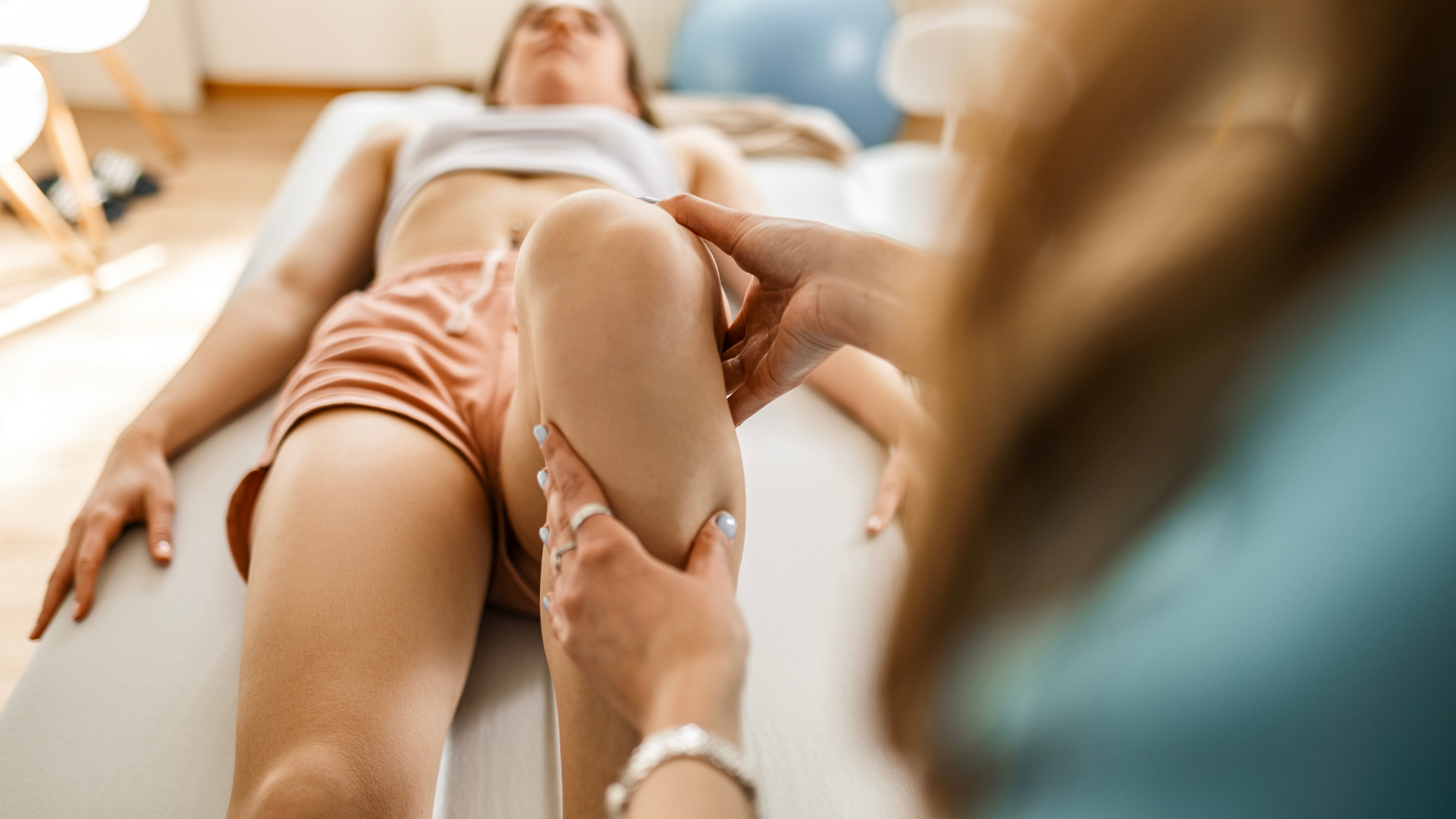
During your physiotherapy assessment, your physio will watch how your kneecap tracks during movement, test the strength and control of your hip and thigh muscles, and assess how you manage functional tasks like squatting or stepping down.
One specific test — the patellar apprehension test — gently moves the kneecap outward to see whether it provokes that familiar feeling of fear or instability. It sounds simple, but it's remarkably telling.
Other conditions such as ACL injuries, meniscus tears, or cartilage damage can sometimes present similarly, which is why a thorough assessment matters so much before jumping to conclusions — or imaging.
Do I Need a Scan?
Not necessarily — especially after a first episode. Physiotherapy assessment alone can guide early management very effectively in most straightforward cases.
That said, imaging does have a role. X-rays can rule out a fracture or identify any obvious alignment issues, while an MRI provides a more detailed picture of the MPFL, cartilage surfaces, and any bone bruising that may have occurred at the time of dislocation.
Scans become more important when the kneecap has fully dislocated, when there's significant swelling suggesting possible cartilage damage, or when instability keeps recurring despite rehabilitation. Even then, the images are just one piece of the puzzle — your physiotherapist will always interpret findings alongside how your knee is actually functioning, not in isolation.
Treatment
The good news is that physiotherapy is the cornerstone of treatment for the vast majority of people with patellofemoral instability — and it works.
Early phase (protection and recovery) In the days and weeks immediately after an episode, the focus is on settling things down. This means managing pain and swelling, protecting the knee with taping or a brace where helpful, and gradually restoring movement and the ability to walk comfortably. It's not about pushing through — it's about giving the tissues the right conditions to recover.
- Strength and control phase
- Once the acute phase has settled, the real work begins. Strengthening the quadriceps — particularly the VMO — helps guide the kneecap more precisely through its groove. Equally important is building strength in the hip muscles, especially the glutes, which play a surprisingly large role in controlling knee alignment from above. Core stability work adds another layer of support to the whole system.
- Movement retraining
- Strength alone isn't enough if the movement patterns driving the injury haven't been addressed. Your physiotherapist will work with you on technique — how you squat, descend stairs, land from a jump, and cut during sport. Small adjustments in movement can dramatically reduce the load placed on the patellofemoral joint and the risk of another episode.
- Return to sport training
- The final phase bridges rehabilitation and sport. This involves progressively reintroducing jumping, landing, agility, and direction changes in a controlled way — building the confidence and physical capacity to return to full activity safely.
Other treatment options
Taping and bracing can be useful tools throughout rehabilitation, offering support and improving confidence during the recovery process. Anti-inflammatory medication may ease early pain and swelling. We recommend consulting your doctor or pharmacist on the use of anti-inflammatory medications.
For those with recurrent dislocations or significant ligament damage, surgery — typically an MPFL reconstruction — may be recommended. Importantly, physiotherapy remains central both before and after any surgical intervention to ensure the best possible outcome.
How Long's It Going to Take?
Recovery timelines vary depending on the severity of the injury and whether it's a first episode or part of a longer pattern.
A first-time subluxation will often see functional recovery within four to eight weeks, with a return to sport typically somewhere between eight and twelve weeks — provided strength, control, and confidence are where they need to be. More complex or recurrent cases naturally take longer, and those who have had MPFL reconstruction surgery should expect a return-to-sport timeline of around four to six months.
The most important factors? How well the hip and quadriceps muscles respond to training,
and how consistently the rehabilitation program is followed.
Cutting corners here is the most reliable way to end up back at square one.
The Take Home
Patellofemoral instability can be a frightening experience — a kneecap that shifts out of place doesn't exactly inspire confidence. But it's also one of the conditions that responds exceptionally well to physiotherapy when it's caught early and managed properly.
The key is building the strength and movement control that keeps the kneecap where it belongs, so that the ligaments and bones don't have to do all the work alone. Whether you've had a single episode or are dealing with ongoing instability, a thorough physiotherapy assessment is the best first step toward understanding what's driving the problem — and building a clear, personalised plan to fix it.
Injured your knee and want to get it sorted? Give us a call.
At Movement for Life Physiotherapy, we can assess and diagnose your knee injkury and let you know whether you have a subluxed your kneecap, injured your ACL, or if there is something else going on. With a clear diagnosis and tailored management plan, we'll help get you back to the things you love sooner.
Call now or click on BOOK AN APPOINTMENT to book online.
References
- Huntington, L. S., Webster, K. E., Devitt, B. M., Scanlon, J. P., & Feller, J. A. (2020). Factors associated with an increased risk of recurrence after a first-time patellar dislocation: A systematic review and meta-analysis. American Journal of Sports Medicine, 48(10), 2552–2562. https://doi.org/10.1177/0363546519888467
- Nomura, E., Inoue, M., & Osada, N. (2005). Anatomical analysis of the medial patellofemoral ligament. Knee Surgery, Sports Traumatology, Arthroscopy.
- Flores, G. W., de Oliveira, D. F., Ramos, A. P. S., Sanada, L. S., Migliorini, F., Maffulli, N., & Okubo, R. (2023). Conservative management following patellar dislocation: A level I systematic review. Journal of Orthopaedic Surgery and Research, 18, 393. https://doi.org/10.1186/s13018-023-03867-6
- Dennis, E. R., Gruber, S., Marmor, W. A., & Shubin Stein, B. E. (2022). Evaluation and management of patellar instability. Annals of Joint, 7, 2. https://doi.org/10.21037/aoj-2020-02
- Migliorini, F., Maffulli, N., Bell, A., & Betsch, M. (2022). Outcomes, return to sport, and failures of MPFL reconstruction using autografts in children and adolescents with recurrent patellofemoral instability: A systematic review. Children, 9(12), 1892. https://doi.org/10.3390/children9121892
- Platt, B. N., Bowers, L. C., Magnuson, J. A., Marx, S. M., Liu, J. N., Farr, J., & Stone, A. V. (2022). Return to sport after medial patellofemoral ligament reconstruction: A systematic review and meta-analysis. American Journal of Sports Medicine, 50(1), 282–291. https://doi.org/10.1177/0363546521990004
- Hsu, C.-J., Lee, C., Christensen, R. S., & Liu, T. Y. (2025). Current concept review: Medial patellofemoral ligament reconstruction: From rehabilitation to return to sport. International Journal of Sports Physical Therapy, 20(7), 1074–1090. https://doi.org/10.26603/001c.141128
- Steensen, R. N., Dopirak, R. M., & McDonald, W. G. (2005). The anatomy and isometry of the medial patellofemoral ligament. American Journal of Sports Medicine.
- Hing, C. B., Smith, T. O., Donell, S., & Song, F. (2011). A systematic review on the management of patellar instability. Knee Surgery, Sports Traumatology, Arthroscopy.
- Sillanpää, P., & Mäenpää, H. (2012). First-time patellar dislocation: Surgery vs conservative treatment. Sports Medicine and Arthroscopy Review.
- Panni, A. S., Cerciello, S., Maffulli, N., & Di Cesare, M. (2013). Patellar instability and MPFL injury patterns. Knee Surgery, Sports Traumatology, Arthroscopy.
More articles